securion.ai
  • Solutions
  • Cyber & Cloud Security
  • Frameworks
  • Resources
  • Contact Us
SolutionsCyber & Cloud SecurityFrameworksResourcesContact Us
securion.ai

Advanced AI agents for cybersecurity automation and threat detection.

Resources

  • Resources
  • Contact Us

Legal

  • Privacy Policy
  • Terms of Service

© 2026 Securion.ai. All rights reserved.

Back to Resources
General 7 min read

The CIA Triad Explained: Confidentiality, Integrity, Availability

The CIA triad in simple terms: what confidentiality, integrity, and availability mean, everyday examples of each, how they fail, and how to protect them.

The CIA Triad Explained: Confidentiality, Integrity, Availability
In This Article
  • Overview
  • What is the CIA triad?
  • Why the CIA triad matters
  • Confidentiality: keeping data private
  • Integrity: keeping data accurate and trustworthy
  • Availability: keeping systems and data accessible
  • The triad in balance: the three pull against each other
  • A worked example: an online store
  • Beyond the triad
  • How the triad shows up in the real world
  • Key takeaways
  • Frequently asked questions

Overview

The CIA Triad Explained: Confidentiality, Integrity, Availability

If you learn only one model in cybersecurity, make it this one. The CIA triad is the foundation the entire field is built on, and once it clicks, every tool, control, and headline suddenly makes sense.

This guide explains the three ideas in simple terms, with everyday examples, how each one fails, and how organisations protect them. No jargon, no scare tactics.

New to security entirely? Start with What Is Cybersecurity? and come back here.

What is the CIA triad?

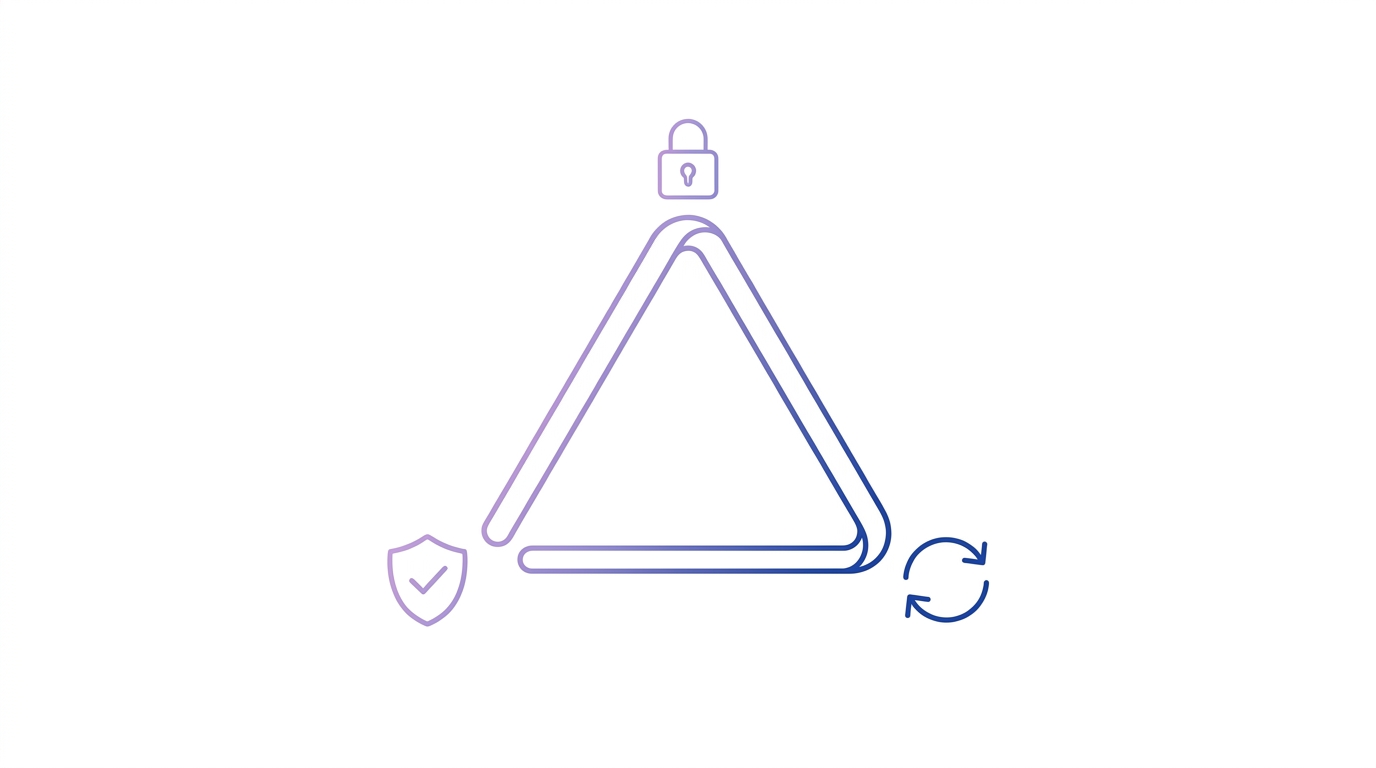
The CIA triad is a model that defines the three core goals of information security: Confidentiality, Integrity, and Availability. (No relation to the intelligence agency.)

Every security measure ever invented exists to protect one or more of these three things:

  • Confidentiality — only the right people can see the data.
  • Integrity — the data is accurate and hasn't been tampered with.
  • Availability — the data and systems are there when you need them.

That's the whole model. Its power is that it turns a vague goal ("be secure") into three specific questions you can actually answer about any system.

Why the CIA triad matters

Security can feel like an endless list of tools, threats, and acronyms. The triad gives you a way to organise all of it. Whenever you look at a control, a risk, or a breach, you can ask: which of the three is this protecting, or which one failed?

  • A password protects confidentiality.
  • A backup protects availability.
  • A tamper-proof audit log protects integrity.

Every breach is ultimately a failure of one or more of these three. So the triad isn't just theory. It's the checklist professionals run in their heads, and it's the backbone of compliance frameworks like SOC 2 and ISO 27001.

Confidentiality: keeping data private

Confidentiality means ensuring that information is only accessible to the people authorised to see it.

Everyday example: typing a password to open your email. The password is what keeps everyone else out. When your messaging app encrypts your chats, that's confidentiality too, nobody in the middle can read them.

How it fails: a database left exposed to the public internet, a laptop stolen with unencrypted files, an employee emailing a customer list to the wrong address, or an attacker stealing login details through phishing.

How organisations protect it:

  • Encryption — scrambling data so it's unreadable without the key, both when stored and when moving across a network.
  • Access controls and least privilege — giving each person access only to what they genuinely need.
  • Strong authentication — especially multi-factor authentication (MFA), so a stolen password alone isn't enough.
  • Classification — knowing which data is sensitive so you can protect it accordingly.

Integrity: keeping data accurate and trustworthy

Integrity means ensuring that information is accurate, complete, and has not been altered by anyone unauthorised.

Everyday example: your bank balance. It needs to be correct, and it needs to stay correct. If someone could quietly change a number in the bank's database, the money itself would become meaningless. The same applies to a medical record, a legal contract, or the code you deploy to production.

How it fails: an attacker modifying records, a faulty process corrupting a file, or malware silently changing data. Ransomware is partly an integrity attack, it alters your files so you can no longer use them.

How organisations protect it:

  • Hashing and checksums — a kind of digital fingerprint that reveals if even a single character has changed.
  • Digital signatures — proving a file or message genuinely came from who it claims to, unmodified.
  • Access controls and change management — limiting who can alter data, and recording every change.
  • Audit logs — a tamper-evident trail of who did what and when. This is also exactly what auditors ask for as evidence.

Related: the way changes are recorded is central to proving security. See SOC 2 & ISO 27001 Explained.

Availability: keeping systems and data accessible

Availability means ensuring that systems, services, and data are accessible to authorised users when they need them.

Everyday example: being able to open your files, load a website, or process a payment right when you need to. Security that locks out the legitimate users is a failure too, an unusable system protects nobody.

How it fails: a ransomware attack that encrypts your files, a distributed denial-of-service (DDoS) attack that floods a website until it collapses, a server crash, or even a simple power cut or accidental deletion.

How organisations protect it:

  • Backups — tested, recent copies, so a disaster becomes an inconvenience.
  • Redundancy and failover — spare capacity that takes over when something breaks.
  • DDoS protection — filtering out flood traffic before it overwhelms a service.
  • Monitoring and patching — catching failures early and closing the weaknesses attackers exploit.

The triad in balance: the three pull against each other

Here's the part most beginners miss. The three goals are in constant tension, and good security is about balancing them, not maximising one.

  • Turn confidentiality up to the extreme, encrypt everything, demand five passwords, and you hurt availability: the system becomes painful to use.
  • Make something perfectly available to everyone, and you risk confidentiality.
  • Lock data so tightly that nobody can update it, and you protect integrity while destroying usefulness.

A bank vault is extremely confidential and high-integrity, but terrible for availability, you can't get your valuables at 3am. A public noticeboard is highly available but has zero confidentiality. Every real system sits somewhere in between, and the right balance depends on what the data is.

Deciding that balance for each system is a huge part of what security professionals actually do.

A worked example: an online store

Watch all three appear at once in a system you already understand.

  • Confidentiality: customers' card details and addresses must be visible only to them and authorised staff, so the store encrypts them and restricts access.
  • Integrity: prices, orders, and inventory must be accurate. If an attacker could change a price to zero or alter an order, the business breaks, so changes are controlled and logged.
  • Availability: the store must stay online, especially during a sale. Downtime means lost revenue, so the store uses redundancy, backups, and DDoS protection.

One ordinary website, and every security decision behind it maps cleanly onto one of the three goals.

Beyond the triad

The CIA triad is the foundation, but you'll sometimes hear two more concepts added for completeness:

  • Authenticity — confirming that people and data are genuinely who and what they claim to be.
  • Non-repudiation — ensuring someone can't later deny an action they took (closely tied to integrity and audit logs).

You don't need these to get started. Master the three, and the rest slots in naturally.

How the triad shows up in the real world

The CIA triad isn't just a classroom model. It's baked into how modern security and compliance work:

  • Compliance frameworks (SOC 2, ISO 27001) are essentially structured ways of proving you protect confidentiality, integrity, and availability.
  • Cloud security is largely about configuring access (confidentiality), controlling changes (integrity), and building in resilience (availability). Most cloud breaches are a confidentiality failure caused by a misconfiguration.
  • Modern security tooling increasingly closes the loop automatically: find the exposure, fix it, and record the change as tamper-evident evidence, protecting all three at once while producing the audit trail.

Go deeper: Cloud Security 101 and The 10 Most Common Cyber Attacks.

Key takeaways

  • The CIA triad is the foundation of security: Confidentiality, Integrity, Availability.
  • Confidentiality = only the right people can see it. Integrity = it's accurate and untampered. Availability = it's there when needed.
  • Every security control and every breach maps to one or more of the three.
  • The three are in tension — good security balances them for the specific data, rather than maxing one out.
  • The triad underpins real-world compliance and cloud security, not just theory.

Learn these three, and you're no longer guessing at security. You have a framework that makes the whole field readable.

Frequently asked questions

What does CIA stand for in cybersecurity? Confidentiality, Integrity, and Availability, the three core goals of information security. It has nothing to do with the intelligence agency.

Why is the CIA triad important? It gives security a clear structure. Every control, risk, and breach can be understood as protecting or failing one of the three goals, which makes it the mental model professionals use daily and the basis of frameworks like SOC 2.

Can you give an example of the CIA triad? An online store: card details kept private (confidentiality), prices and orders kept accurate (integrity), and the site kept online during a sale (availability).

What is the difference between confidentiality and integrity? Confidentiality is about who can see the data. Integrity is about whether the data is accurate and unaltered. You can have one without the other, a public document (no confidentiality) can still have perfect integrity.

Is the CIA triad still relevant? Yes. Despite newer additions like authenticity and non-repudiation, the triad remains the foundational model taught and used across the whole industry.


Get one clear security briefing a month, what auditors changed, what attackers changed, and nothing else. Subscribe to the Securion monthly briefing.

Why Securion?

  • AI-driven threat detection across cloud and SaaS
  • Continuous compliance for SOC 2, ISO 27001, and more
  • Hundreds of security agents — no extra headcount
  • Live audit trail your auditors can self-serve
Try Securion Free
Article Info
Author
Saravanakumar Malaichami, Founder, Securion.ai
Published
9 August 2026
Read time
7 min read
Tags
cia triadfundamentalsconfidentialityintegrityavailability
securion.ai
  • Solutions
  • Cyber & Cloud Security
  • Frameworks
  • Resources
  • Contact Us
Login
SolutionsCyber & Cloud SecurityFrameworksResourcesContact Us
Login